Award-winning renowned sommelier Olivier Flosse brings a wealth of experience gained in Europe and New York City to his work in organizing private wine dinners and wine tastings as well as seminars on wine at the Westchester Wine Warehouse where he also manages the fine wine room. A two-time winner of Wine Spectator’s Grand Award, Olivier tells us about what it takes to be an excellent sommelier and shares his philosophy behind the art of experiencing and exploring the wine universe.
You grew up in in Marseille, France, and you encountered wine when you were about 11 years old, thanks to your grandfather. Please tell us about that experience.
One day as a child I had the chance to taste the last drop of one of the best wines opened by my grandfather. I didn’t really like it because I was 11 years old with no experience. But this was part of our traditional Sunday when Grandma was cooking, Grandpa was getting the wine from the wine cellar, and I was going with him. For me, even touching the dust on the bottle was unique, and I had my first taste with an incredible wine from Bordeaux.
You mentioned that you were instantly captivated by the smell of wine…
At that early stage, the smell was more important for me than the taste. Of course, when you are so young, tasting alcohol is definitely not a good way to start your life. But the smell of what I was tasting was something so unique that now, more than 40 years later, I still remember it.
At 14, you worked in a restaurant. Is that when you decided to go into the hospitality industry?
Yes. I was not doing very well at school, and as a punishment, during the summer when all the other kids were enjoying different activities, my mother sent me to work in a restaurant in Marseille to understand what hard work means. From my mother’s expectation for something inside my mind to click and make me say okay, now I’m going to focus on school, the complete opposite happened. I really loved the experience of the restaurant, and it became part of my DNA. I just had to be in contact with people, trying to do the best that I can for them. So, it was really a positive experience for me, but definitely not for my mother.

A private wine tasting in New York City organized by Olivier Flosse
What did you like so much about working in a restaurant?
I liked the contact, I liked the fact that people are sometimes demanding and when you bring them exactly what they want, you have this unique feeling of satisfaction. I do believe that, in life, satisfaction coming from other people is not necessarily something that you have every single day. So, I got my happiness through that and really loved it. From that experience I said: This is where I want to be.
Then you went to school for hospitality management…
I went to an école hôtelière [hotel school] in Marseille and I got super lucky because in the first year they started the sommelier program, so I went into that. Since I didn’t have the degrees I needed for this elite school and they let me in thanks to my former restaurant employer, at the beginning I was ranked last, but I finished first. When you finish in first place, you decide where you’re going to work. To thank my former employer without whom I would never be a sommelier, I offered to go work for him for one year for free in that same restaurant where I had worked at 14. After that year, I asked him to send me to Bordeaux where I stayed for 11 years including four years at the Institute of Vine and Wine Science, which is part of the University of Bordeaux. One thousand students applied and they took only ten.
What do you learn in an institute of wine?
Every aspect about wine from the specificity of the soil—the terroir—the grapes, the varietals, the differences between wine from Europe and from outside of Europe, and the winemaking process. Basically, your teachers are the best winemakers from everywhere in the world. It’s unique, and it was the best time in my life—four years of pure pleasure, getting to taste the best wines in the world and a lot of education about it. We were tasting three times a day.
I think many people wonder about the management of that. How do you handle having to taste wine three times a day?
It’s a different lifestyle. You start very early in the morning. Why? People always asked me: “Olivier, that is crazy, how can you taste wine at 8:00 or 9:00 AM when everybody drinks coffee and has breakfast?” The only way to taste well is to feel well. About an hour after you wake up, most of the time you get to your highest or, at least, a high level of energy. During the day, that energy goes down slowly. The best way for you to smell and taste well is to do it in the morning. For that, you have to prepare yourself. The night before, you need to make sure that you drink a lot of water and not eat too much at night because your stomach must be very clear. Then you wake up early and eat a lot. If you don’t eat a lot and you start tasting wine, you’re not going to function for too long. But it is important to know that you don’t actually drink the wine. You taste the wine, and you spit it out. So, you do a tasting in the morning between 8:00 and 9:00. The second tasting is at Noon because that’s when you start to be hungry and your saliva as well as your senses of food and smell are more active. And the third tasting would be between 3:00 to 4:00 PM.
And how do you feel at the end of a day like this?
I’m going to be honest with you: After the three tastings in which you don’t actually swallow the wine, you’re going to want to eat at a restaurant and drink for real!
After such extensive experience as a sommelier in Europe, how did you decide to come to the United States?
It was pure accident and luck. I was in England, based near Oxford, in Great Milton, at the end of 1998, and I was thinking of where to go next. I worked at a great restaurant with 14 sommeliers, and we had one of the most beautiful wine lists in all Europe. My best friend called me and said: “Olivier, I’m going to New York. Chef Daniel Boulud is opening his new restaurant and it’s going to be the biggest opening of the year. I did an interview and they’re also looking for a sommelier. Would you like me to talk to him?” I said: Yes, of course, I mean, it’s Daniel Boulud, there’s no other possibility like this! Two weeks later, I had an interview with Daniel, and he asked me if I would like to come to the U.S. I said: Absolutely!
So, from my interview with Daniel and the move to the U.S. it took only three weeks. As we had the same philosophy, we were on the same page and had the same desire to work together, Daniel hired me immediately at Daniel Restaurant as a sommelier under the direction of then-wine director Jean-Luc Le Dû. I came here with $600 in my pocket and two suitcases, not knowing where I was going to sleep at night. Lucky enough, I stayed with my friend for a few weeks until I made some money and figured things out. That was the beginning of 26 years of pure pleasure. After that, I became wine director at Café Boulud in NYC and then joined the London-based Marlon Abela Restaurant Corporation. I created the wine lists for the A Voce restaurants. In 2012, for A Voce Columbus, I got the greatest award a sommelier can get: the Grand Award from Wine Spectator for the best wine list. In 2001, I was lucky to be part of the team at Daniel that got this award, but in 2012 it was me who received it with the tremendous help of an incredible team.
How do you put together a winning wine list for a restaurant?
Satisfaction of the customer is, for me, the number one priority. You need to please different tastes, and many people think that having the best wine list in the world means having the most expensive wines on that list. My first experience with wine was with my family who couldn’t afford expensive bottles. But they still had the pleasure of enjoying good wines. So, my priority, which was a very strong point during my interviews with Wine Spectator as we were considered for the award, was to offer, as much as possible, wine under $90. And yes, we are still targeting to have the best wine list in the world, best vintages, incredible cru, but the rest has to have best value for the customers. For me, offering the best value has always been the most important thing.
Building a wine list takes time. It took me close to ten years to build it up to that point of winning the award. It’s very hard work to get the best wine, the best vintages. You have to travel a lot to deal with some wineries that normally don’t offer certain wines, so you can be the only restaurant to have those wines because it has to be a unique list. Then, when Wine Spectator tells you: “We need to control your wine list,” that means you made it among the last 40 wine lists considered for the award. Then they kept narrowing the list down until they gave only four new Grand Awards that year—and all four were in the U.S. I had always followed Wine Spectator; I’m a big fan of what they are doing for the world, not only for wine production but for the people who love wine whether it’s a sommelier or a connoisseur or someone who wants to learn. It’s an extended love of wine from every angle.
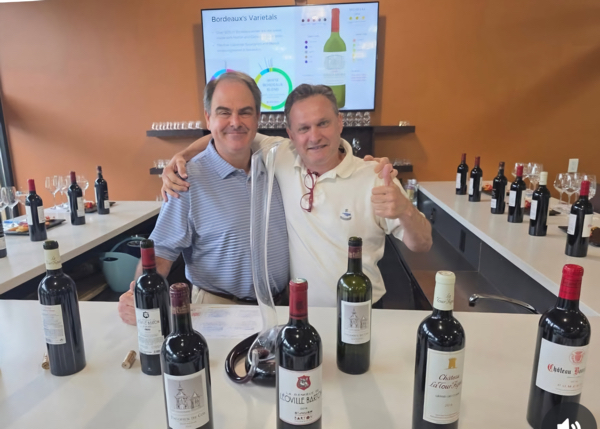
Olivier Flosse with Ken Irving at the Westchester Wine Warehouse
How did you end up at the Westchester Wine Warehouse in White Plains?
It was during COVID. I lost my job in New York City. So, I decided to go to a country club in Larchmont and a friend of mine told me they are looking for someone at the Westchester Wine Warehouse to build up a beautiful fine wine room and to be of support to the team there. I did an interview and now it’s been almost five years since I started there. We do a lot of wine tastings, every Friday, every Wednesday. More and more people want to come because it’s not only tasting, it’s also about the discovery of different countries, different winemaking, and sharing whatever knowledge I have with other people. Sharing is caring as we always say, and that for me is super important. I listen a lot to what people say and how they feel, and I try to guide them in the best possible way.
What are some basics beginners should look for when tasting a wine?
The basic thing is to be yourself! Don’t pretend or even try to be somebody else. And at first, if it’s just a matter of “yes, I like this wine and no, I don’t like that one,” that is good enough. It is your own appreciation of something, and it doesn’t have to be more complicated than that. If you want to get better at it, you need to spend time with it, to buy different types of wine, taste, make some notes, attend lectures, and study a bit. I still study two to three hours every single day, on different but related subjects. The wine world evolves incredibly fast.
Why do you think that wine has always been so important for humans?
Sharing wine means different things: it can be between friends, loved ones, it can be for victory, for celebration, for sadness. Wine brings people together, and yes, also with food.
The art of pairing is fascinating too. How would people educate themselves about ideal pairings of wine with food, aside from the Internet, of course?
Pairing is extremely individual.
But there are some elementary principles, aren’t there?
In fact, no. I believe each person has a different feeling for food and wine. For many years people have said: “You must have red wine with cheese!” I do not drink red wine with cheese. Depending on the kind of cheese, I love to have champagne and white wine with it. It’s really according to what you feel. Yes, most of the time red meat and red wine work together. But if you are not a red wine drinker and you like meat, why not have a white wine with it?
So, you’re saying that there are no rules…
In my opinion, there are no rules. The only rule is your happiness. According to your feeling, match whatever you want.
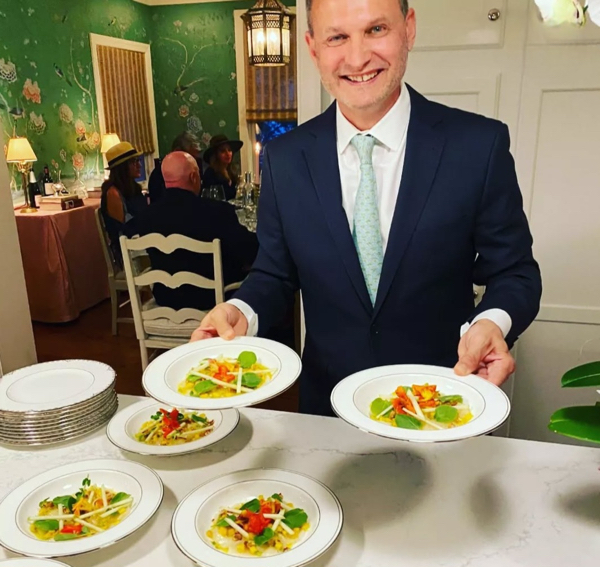
Olivier Flosse preparing a private wine dinner
I know that you organize private wine dinners in people’s homes. Tell us more.
Because of my background as a sommelier in top restaurants in Europe plus in the U.S., people get interested in experiencing that. To do that in a restaurant costs a lot of money. A few years ago, I decided to offer people the same experience in their own homes. It could be for 10,15, 20 people, according to the size of your kitchen or your house. I do this throughout Westchester and New York City. With my team, we prepare the food, and we match it perfectly with the wine. I usually decide the menu with the chef based on what the host likes, and we make sure that our hosts and guests have no allergies. The host tells me first if they want to do French or Italian, or if they love specific things, like oysters or lamb, etcetera. And there is a lot of preparation before the event. We buy all the ingredients, and we cook in your kitchen.
Do you also bring the wine?
We use the customer’s wine most of the time. If they really want something special, we help them get the wine.
So, do you often create the menu based on the wine they have?
That is a very good question! It could be that, according to their wine selection, we create the menu, or we create the menu first and then they get the wine. It doesn’t matter which way; it’s 100% satisfaction anyway.
How can people contact you if they are interested in booking a private wine dinner with you?
My e-mail is olivierflosse@gmail.com and follow me on Instagram as well @flosseolivier where they can also see videos and photos of these dinners. We’re doing about 15 wine dinners a year, especially in October, November, and December. It’s really an incredible experience!
You offer private wine tastings as well…
Yes, also in your home. I do about 50 to 60 private wine tastings a year. You could have 10, 50 guests, it doesn’t really matter. It could be for a birthday, an anniversary, or just for the pleasure of it, and you get a one-hour talk about the wines we’re tasting. First, I usually exchange ideas with the customers, and according to what they like, I might recommend different regions, so we work together. We taste between four, six, sometimes ten different wines for up to three hours, and each tasting is based on a very specific region. I also do this type of tasting for companies for big groups of 70 to 100 people. I just did one for Amazon, and I’m also doing one for MasterCard this year. I give them all the details they need to be ready for the tasting, and they are in charge of getting the wine.
As we are approaching Thanksgiving and the holidays, do you have any recommendations of wine for people to explore?
I would say, better to have quality instead of quantity. So, I would recommend to reduce the number of bottles but increase the level of quality and you don’t have to spend a fortune for that. You just need to figure out a way to have someone who can advise you. Perfect example: Everybody says: “Oh my God, champagne is expensive!” But you do have non-expensive champagne, and you have other options made in the same way such as cava from Spain, crémant—there are eight—from France or Franciacorta from Italy. They’re all made by the same method as champagne but much less expensive and as good as most good champagnes. Of course, there are exceptional champagnes, superb, unique, and you cannot compare with them. But you can have an amazing bottle of crémant at $30 to $40.
You’re not too crazy about prosecco…
I will say that prosecco is a very specific type of sparkling wine. If people like prosecco for whatever reason I am okay with that, but at the same time, I can say that, for almost the same price, you can have a cava or a crémant, maybe a few dollars more but of much higher quality. I mean, prosecco is okay, let’s say it’s Sunday, you’re on the beach, you put a little bit of orange juice in it, whatever makes you happy. I’m not against it but if I have to choose, I will go with cava, crémant or Franciacorta, and of course, champagne.
And for a turkey dinner?
It’s incredible that many people like to have heavy red wine with turkey; it’s completely the opposite for me. I love white wine with turkey. It’s a dry meat, so if I drink heavy red wine, organically, the dry tannins will increase this feeling of dryness, and you don’t need more dryness. Have a red that’s a little bit lighter, more fruit oriented, like a pinot noir. Cabernet, depending where it comes from, could be an option, yes, but I would like to have something lighter. Or it could be a white wine from Italy. I would suggest a more concentrated white wine with more body like chardonnay. There’s incredible wine from Sicily from Spain, from the U.S. I’m a big fan of Oregon wines from Willamette Valley. We need to support the wines from the U.S. Thanksgiving means a lot of food, and most of the time, a lot of wine. So, the lighter you go the better off you will be by the end of it. It doesn’t need to create a competition of flavors, so you won’t finish your Thanksgiving feeling like an elephant because you’ve eaten and drunk for four days in one. Lighter wine is definitely better for this holiday.
Any other wise words about the art of wine?
Again, try to focus on quality. If you don’t know, ask. If you’re going somewhere and nobody can give you the correct answer, search on the Internet. And go to wine tastings where you are going to learn something. Knowledge is power so the more you know the better you will understand the world of wine, and the greater you will feel about sharing that with somebody else. It’s all about sharing. And again, there are no rules. I will tell you a little story: Every time I go to France, I open a very good bottle of wine for my family, and every single year, my mother puts ice into the red wine! But it’s my mother, I’m not going to say anything. It kills me inside, and it kills her inside because she’s looking at me and she knows what I’m feeling. She tells me: “It’s the way that I love my red wine!” And I say: “Mom, if this is the way that you love your wine, this is how you’re going to drink it.” No rules!
To book a private wine dinner or wine tasting, contact Olivier Flosse at: olivierflosse@gmail.com
Follow Olivier Flosse on Facebook and Instagram @flosseolivier
Attend a wine tasting and seminar at The Westchester Wine Warehouse
Top photo: Olivier Flosse
All photos courtesy of Olivier Flosse