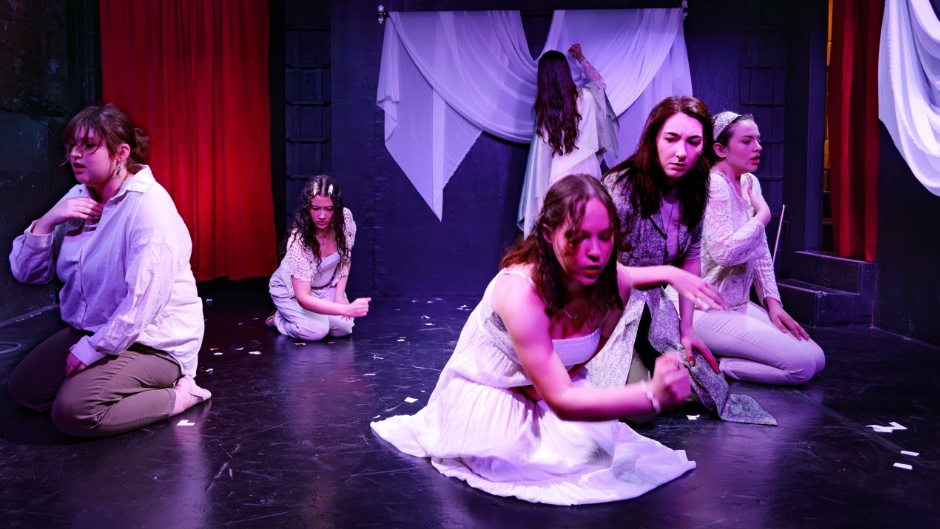
After 2,500 years, there are still good reasons to revive Antigone and make it resonate with today’s audiences. In this sixty-minute production, courtesy of the NYC Fringe Festival, there’s no need for “modern dress.” White clothes and wraps of white fabric suffice for the all-female cast to evoke ancient Thebes on a bare stage. Although this version is, for no apparent reason, titled Anti-Gone, the heroine is still conventionally addressed as “an-TIG-o-nee.”
At the risk of her own life, Antigone (Sivan Raz, who’s also the producer) gives her dead brother funerary rites, thereby defying an edict from the tyrannical king Creon (Emily Ann Banks) to let him rot. Antigone’s sister Ismene (Penelope Rose Deen, who’s also the choreographer) initially tries to dissuade her, but later tries to save her by confessing to the crime herself. Creon rejects a warning from the blind seer Teiresias (Jenny Reich Litsky, also a co-producer) and orders Antigone to be entombed, alive, in a cave.
At that moment on stage, Anti-Gone comes to a full stop. Antigone addresses the audience, declaring that, since ancient Greece invented democracy, the audience should now suggest alternative endings, and vote to determine how the play will conclude. On opening night, three endings were called out: (1) Ismene usurps Creon’s throne to become queen; (2) Antigone marries Creon’s son Haemon (Tiffany Munoz) and live happily ever after; and (3) Haemon kills Creon and becomes king.
The majority went with the fairy-tale ending, so the cast regrouped and prepared for the nuptials. But Antigone—and Creon—suddenly stop the show, insisting that this new ending will not work. So they restart the play just before the audience got involved, and resolve it the way Sophocles did: Creon relents, but Antigone dies before her cave is opened.
Antigone is the final play in a melodramatic trilogy that begins with Oedipus Rex, and many of the speeches allude to it. Before you go, consider brushing up on the back-story, at least via Wikipedia.
Over the centuries Antigone has been translated into dozens of languages, and staged, adapted and drawn upon by hundreds of playwrights, because the profound issues it raises are eternally relevant. When are the risks of civil disobedience justified? Can we ever really know or be sure of what God wants human beings to do in His name? And to whom does one’s earthly allegiance primarily belong: kin or king?
The modern English translation by Ian Johnston is well-articulated by everyone in the cast; and the Chorus’s songs (arranged by Joni Griffith and featuring Belle Rue) are mellifluous and engaging. Anti-Gone comes across like a class project by students in an all-women’s college. But as mounted here by Needs More Work Productions, it does not need more work. It’s a clever take on a classic, as is.
Top photo: The cast of Anti-Gone on opening night, in the photo above, are (l-r): Belle Rue, Tiffany Munoz, Sivan Raz, Penelope Rose Deen (standing), Emily Ann Banks, and Jennie Reich Litzky. Photo by Edonis Bacaj.
Performances of Anti-Gone continue in Manhattan at the Under St. Marks Theater, 94 St. Marks Pl., on April 9, 16, and 19. For times and tickets.