What a challenge!
In Four Evangelists Walk Into a Fog, John, Luke, Matthew and Mark inexplicably tumble out of the fog of history and into . . . “Where are we?” They know it’s the first century, CE, and each of them is there to insist that the manuscript he has drafted is the definitive biography of Jesus. But none of them was around when Jesus lived; so everything they’ve written is based on the “notes” they took of what somebody told them.
Of course, they agree on almost nothing. Mark, a commoner, wrote in Aramaic—the language of ordinary Levantine people, such as Jesus—while the others, who see themselves as scholars (two wear glasses) have written in Greek.
How can “the word,” as John wrote, be both “God” and “with God” and yet also be “made flesh?” The others are confused. And what were Jesus’s last words? For John: “It is finished.” For Luke and for Mark: “My God, my God, Why hast thou forsaken me?” But did he say it in Aramaic or in Greek? Anyhow, both quotes can’t be true, since each will lead to a different interpretation of their hero’s teaching.
Weary of fighting for the supremacy of their own testaments, they decide to put all four into one big “New” anthology. It’s a rare moment of agreement, captured in the photo above, with (l-r) Nick Freedson as Luke, Matthew Foley as John, Zephyr Caufield as Matthew, and John Gionis as Mark. (Photo by Jonathan Slaff.)
But it doesn’t last. They cut deals on the side to determine “who goes first.” And just as important: who goes last! For the man who gets the final word, “the shekel stops there.”
What are they really doing? Are they leading fellow Jews to recognize Jesus as the Messiah? Or are they creating an entirely new religion with its own rules? That’s what epistle-writer Paul insists on when he, too, tumbles out of the mist and into their midst.
Wait! There’s more. A woman shows up, calling herself Maria. She declares that she’s “the Magdalene” who “saw him, talked with him, and touched him,” and that she was there when he said, “Whoever is without sin, let him cast the first stone.” So her own manuscript must be the truest, most historically accurate take on “the man I loved.” She even knows where the loaves and fishes came from!
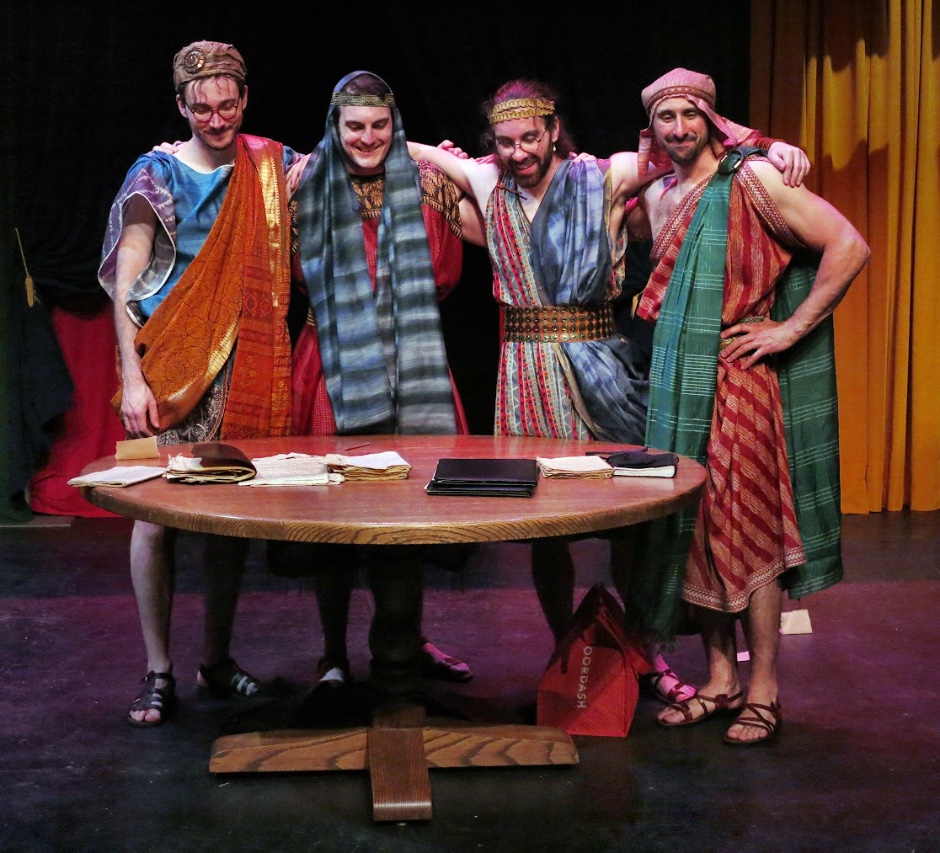
Nick Freedson as Luke, Matthew Foley as John, Zephyr Caufield as Matthew, John Gionis as Mark. Photo by Jonathan Slaff
But the men are certain that a woman can’t be their equal, even if she can read their depositions and write her own. She has no bona fides. (As Matthew says about Jesus’s mother Mary: “Women don’t have ancestors, they have husbands.”)
The playwright, Douglas Lackey, is a professor of philosophy who specializes in creating what he calls “comedies of ideas.” I very much enjoyed his 17th-century Spies for the Pope. This play is just as brilliant, though a little less of an eye-opener, as it treads more familiar ground, and the dialog is more easily punctuated by anachronistic groaners.
Lackey holds with modern-day scholars that the gospel writers John and Matthew were not the apostles so named, but were Jews who lived and wrote later in that century. In this play he situates them in the Talmudic tradition of debating every biblical word and phrase.
Matthew Foley (John), Nick Freedson (Luke), Zephyr Caulfield (Matthew), John Gionis (Mark), Andy English (Paul) and Barbara McCulloh (Maria) are all splendid ensemble players. The set by Mark Horborth, lit by Scott Andrew Calley, and the costumes by Anthony Paul-Cavetta and the props by Buffy Cardoza, are all appropriately middle-easternish.
Harborth also directed the show, which is stage-managed by Cassidy Byron. They keep Lackey’s 65 high-verbal minutes moving right along. You can expect to have much to talk about after seeing this clever comedy of ideas.
Four Evangelists Walk Into a Fog
Through May 18
Manhattan’s Theater for the New City
155 First Avenue
Top photo: Andy English as Paul, Barbara McCulloh as Mary Magdalene, Matthew Foley as John. Photo by Jonathan Slaff