Artist Georgia O’Keeffe and rancher/photographer Maria Chabot
Georgia O’Keeffe (1887-1986), called the “Mother of American modernism,” developed her reputation painting organic forms, especially flowers (200 paintings), rocks, bones, and desert landscapes influenced by places she lived. A surprising quote from one of her letters: “I hate flowers, I paint them because they’re cheaper than models and don’t move.”
Professional relationship with much older, iconic photographer Alfred Steiglitz evolved into marriage after six years of legal difficulty with his family. Soon, O’Keeffe started spending part of each year in New Mexico which inspired her work. The couple had an open relationship, seemingly cavalier for him, difficult for her. O’Keeffe traveled back and forth the rest of her life either staying with or housing devoted women companions while Steigliz had successive affairs.
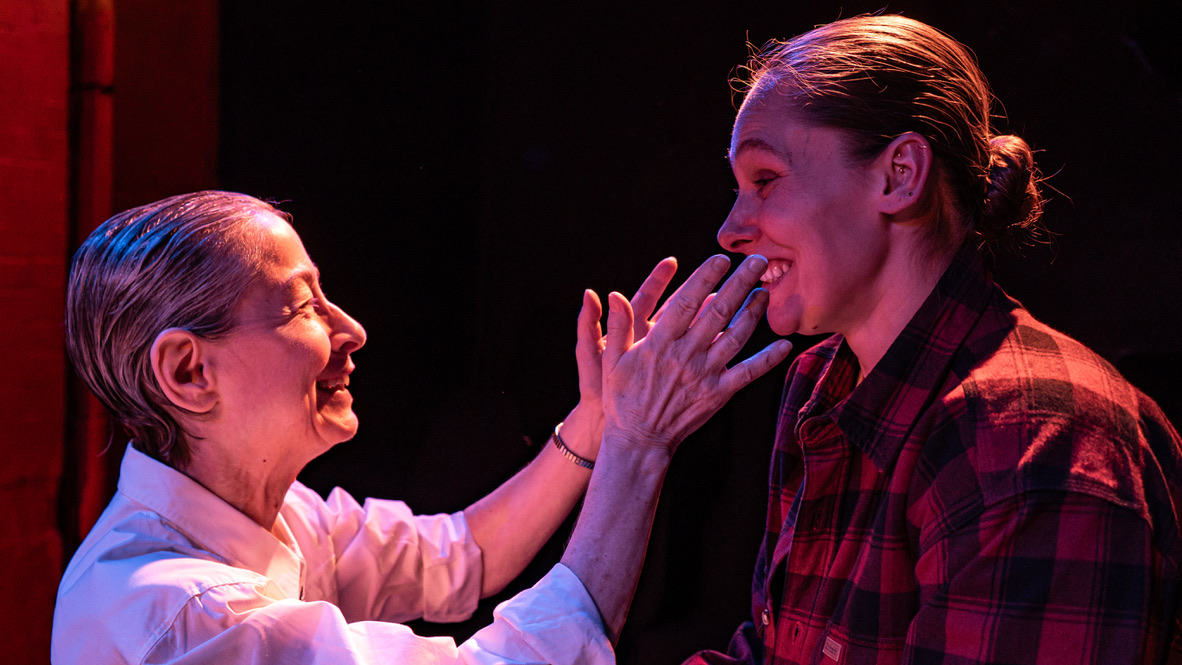
Gael Schaefer (Georgia O’Keeffe), Ria T. DiLullo (Maria Chabot)
Rancher Mary Cabot Wheelwright (Haneen Arafat Murphy) ushers us into the scenario stating she knew both women. The narrator unobtrusively adds a bridge or two, stepping in as herself in brief parentheses. Georgia O’Keeffe (Gael Schaefer) was 52 and gender fluid when she met 19 year-old lesbian, Maria Chabot (Ria T. DiLullo). “They were both in love with Georgia O’Keeffe.” (At one point, Mary hired Maria to run her own ranch, though the younger woman persisted in taking care of what she perceived as Georgia’s needs.)
Maria Chabot is often minimized in O’Keeffe biographies. Through letters, sometimes read (either in prop letter form or too often from scripts), sometimes spoken, we’re served an exhaustive, blow by blow of the women’s on and off nine year relationship. There’s little early warmth or connection in choice of material.
Maria would lay down her life for Georgia. Whenever she sticks up for herself, she subsequently apologizes. O’Keeffe is imperious, selfish, and cruel; cohabiting with successive women, kicking Maria
out like an unwanted servant. She sometimes dispenses inadequate checks which are most often returned. The artist’s young lover was obtuse to the extent of self-flagellating, convinced her worth
would eventually be recognized and valued.
Whatever imbalances and dysfunction there may have been between these incredibly strong-willed and visionary women, one cannot dispute that the camping trips with Maria resulted in some of Georgia’s most iconic landscapes, and that the house and garden at Abiquiu, designed and built by Maria “It took six months to get the pigs out of the house” stand as a stunning testament to a young lesbian’s all-consuming devotion to her muse. (The Program)
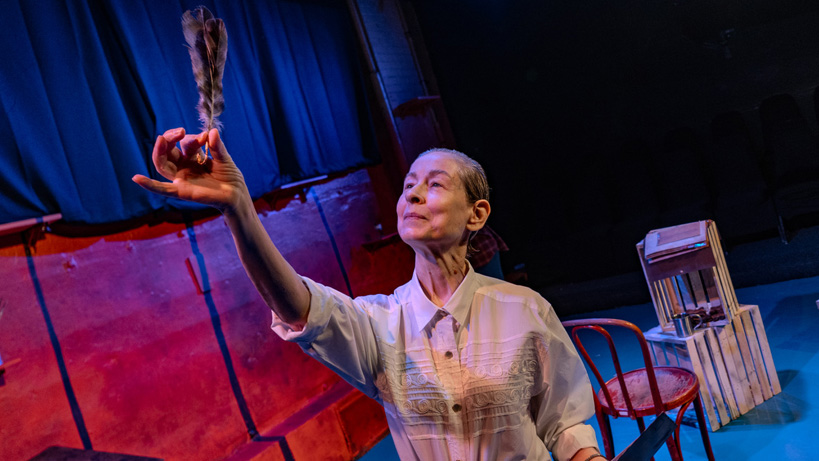
Gael Schaefer (Georgia O’Keeffe)
Adaptation/editing (Carolyn Gage ) comes down hard on Georgia. More balance might’ve allowed us to make up our own minds. Calling out passing years by date is unnecessary and academic as is identifying every single trip Georgia made. Other women in Georgia’s life, however, might’ve been allotted a single descriptive adjective.
Despite the fact that Chabot was an advocate for Native American arts who worked at the federal Indian Arts and Crafts Board, was made the executive secretary of the New Mexico Association on Indian Affairs, and established the annual Santa Fe Indian market, we hear no references to involvement with that aspect of her life. Surely this must’ve been touched upon in letters.
Gael Schaefer offers a credibly hard, calm, singularly motivated, rather magisterial Georgia O’Keeffe
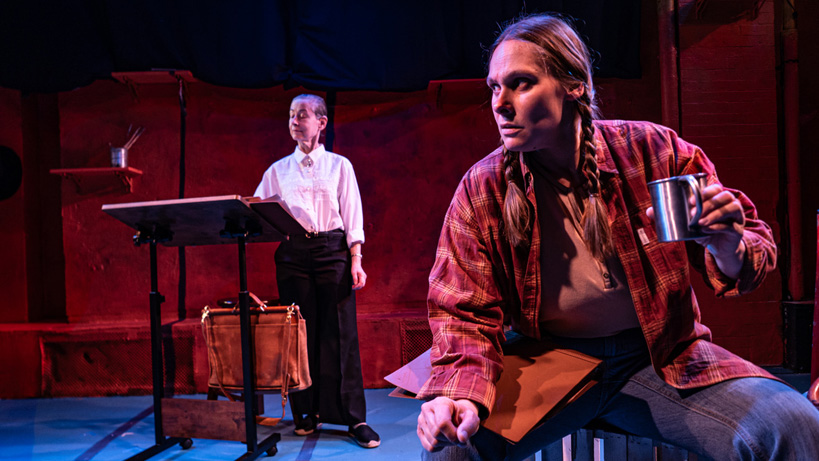
(if only the actress didn’t read so much). Impatience and restraint are palpable. Having a sketch on her easel is a nice touch. As Mary, Haneen Arafat Murphy is marvelous; subdued though emotionally affected, listening and watching with sustained attention, nuanced reaction.
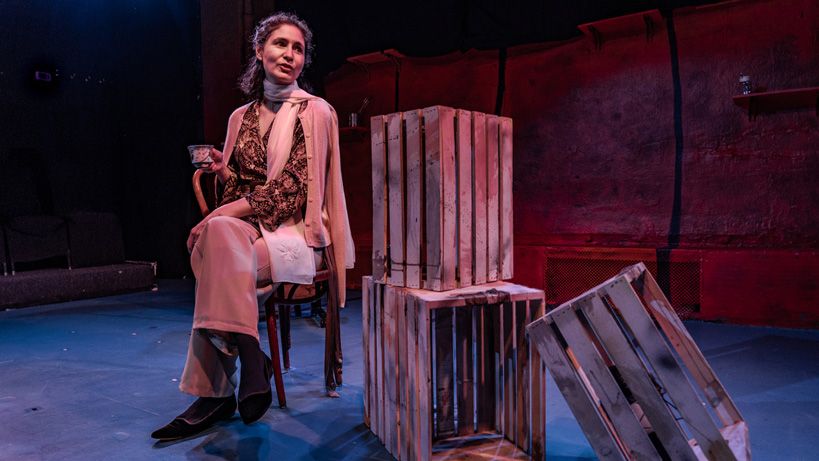
Haneen Arafat Murphy (Mary Cabot Wheelwright)
Ria T. DiLullo’s Maria performs as if in another play. She’s excessively petulant and loud, consistently over dramatic. Gritted teeth, fake coughs or laughs, flexing facial muscles…This is not Greek tragedy. Complete lack of verisimilitude not only creates imbalance but irreparably damages the production. If Arafat Murphy had been cast as Maria we would likely have believed blind determination paired with heartbreak.
Letter plays are challenging. We’ve had several more successful ones this year, with protagonists acting separately until they meet. Attempting to use physical proximity much of the play, with rare confluence of characters, arrives as an “almost” by director Andrew Coopman. Crates depicting renovation look ridiculous, while Georgia’s easel and sketchbook are well employed.
Robert Gonyo, sound design, creates subtle, evocative atmosphere. Costume designer Hope Salvan dresses the characters just as they might’ve been seen.
Book: Maria Chabot—Georgia O’Keeffe: Correspondence 1941-1949.
Photos by Evan Reed
Georgia and the Butch
Adapted from Maria Chabot & Georgia O’Keeffe Correspondence, 1941-1949
Adaptation by Carolyn Gage
Directed by Andrew Coopman
The Tank
312 W 36th St
Through March 12.