How would you feel were your language forbidden, your culture replaced, possessions annexed, history rewritten? Two out of four of these can be experienced currently in America, but so far not to the extreme of persecution of and loss in Ukraine.
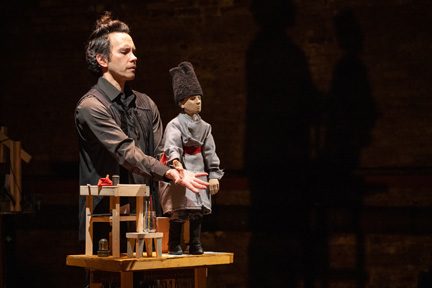
1895. Young Porfiry Martynovych (1856-1933), an 8” puppet, leaves for the Imperial Art Academy in
St. Petersburg. He waves to beekeeper Pavlo (actor/bandura* master Julian Kytasty) who plays and sings. We see both the human and puppet persona. “Oh once there was freedom across steppe/And now there is no freedom…”
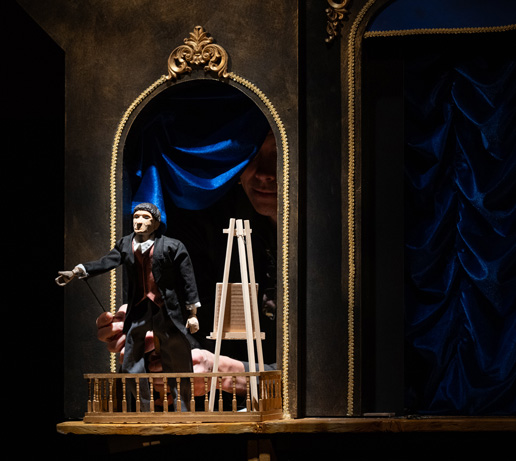
Martynovych puppet (Photo by Pavlo Terekhov)
Martynovych is a skilled artist whose preferred subjects are realistic depictions of the common man. He’s drawn to classic songs by blind storytellers who carry on oral history and fading tradition. When a noted composer asks him (shadow puppets depict) to illustrate an “epic concert” with projections of his drawings, the young man is excited.
“… To look at the very far moon and the stars- you need a telescope. But to create a scene you’ve never seen before, all you need is light in the dark…” A larger version- 18”- of Martynovych (actor/puppeteer Tom Lee) speaks beside a model magic lantern. Lee is marvelous. Every word and expression reflects that of his alter ego.
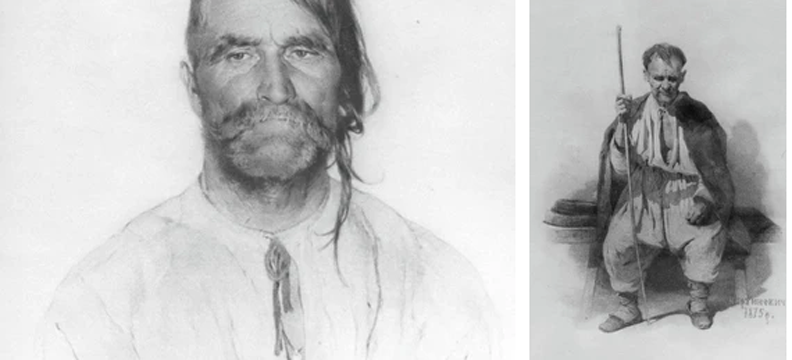
Pencil Drawings by Porfiry Martynovych
Not only might the young man’s art be accepted at last, Ostap Veresai, called the Homer of Ukraine, is to be the performer. Curtain rises on a beautifully appointed theater. Cardboard audience attends. The well known program consists of “How Three Brothers Fled from Azov”:
Siblings escape a Turkish fortress with only two horses. The third boy is left to follow – should he survive pursuit. His brothers will mark the way. Thorn bushes are torn until there are no more at which point red silk ties are employed. Alas, the brother on foot misunderstands. Thinking these remnants of capture, starving and dehydrated, he crawls to a burial mound and dies. Perhaps the moral is meant to parallel fear that culture of Ukraine will give up and perish.
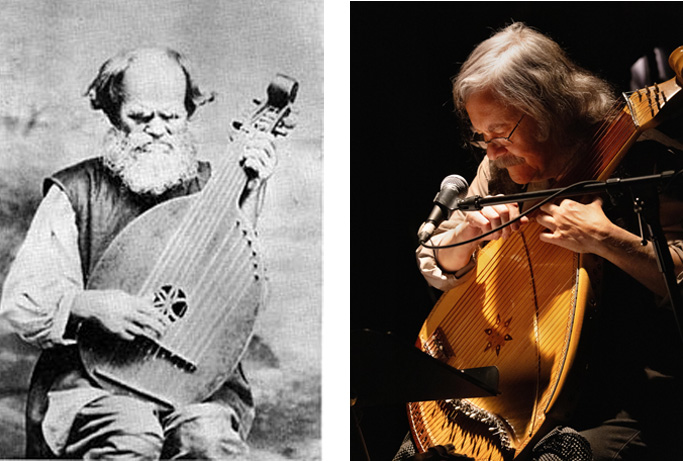
Ostap Veresai; Julian Kytasty
The concert’s reception seems positive, but the streets reveal prejudice: “Those Ukrainians – who do they think they are?…What are the police doing? Why did they allow it?…We must demand strict official censorship…” When the painter finally manages to get two works in an exhibition, his art is condemned
as not sufficiently beautiful “… outside the classical cannon, way below our standards.”
Atop the theater, an extravagantly dressed 8” Tsar declares that “Ukraine never existed, does not exist and shall never exist…” open admonition to wipe out any vestige of nationality. The hero despairs and moves to a small village where he paints what he wants. Traveling, he meets more epic singers seeding hope.
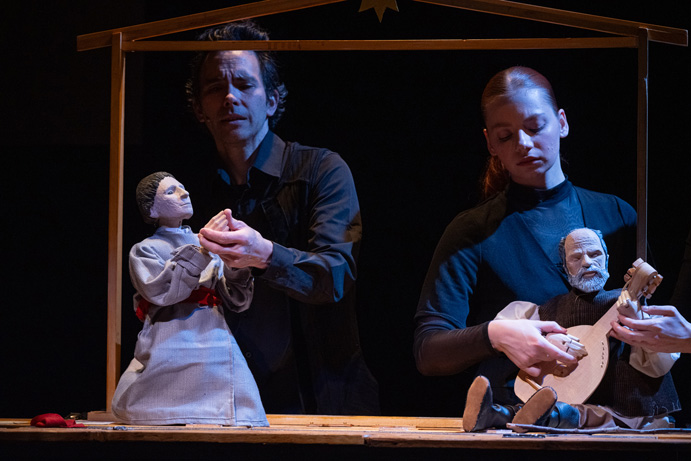
Tom Lee with Porfiry Martynovych puppet and Zlata Godunova with Ostap Veresai puppet (Photo by Pavlo Terekhov)
Puppets are moved from several free standing platforms and the diminutive theater. Changes in size depict perspective. Puppeteers are solemn. (Black gloves would distract less when working from behind the stage.) The production runs smoothly.
A last song by contemporary poet Serhiy Zhadan with music by Julian Kytasty is accompanied by modern photos of war. Without political rhetoric, volume, or violence, Yara Arts Group communicates the struggle and endurance of a proud people -deserving aid- who serve as warning. History repeats itself. We too should be afraid.
“Light. A great light rises on all marked by darkness, on all, so gripped by fear, they can’t walk into a dark home, where they feel a strange presence, where an orphan hears a parent’s voice…”

The scene “The Tsar’s Decree” which bans Ukrainian (Photo by Pavlo Terekhov)
All of the main characters are historical figures. Alas, only one piece of Martynovych’s art is shown.
Use of projection doesn’t live up to the rest of the production which features beautiful puppets and
set pieces (Tom Lee and Andreea Mincic), excellent puppetry, and wonderful musicianship.
The larger issue is lack of supertitles. Much of the piece is in Ukrainian. Though overall intention is clear, too much is lost. As projection mechanism is set up, one wonders at the choice. Translations here are from supplementary materials I received or researched.
Photos courtesy of Yara Arts Group
Opening Tom Lee and Porfiry Martynovych by Pavlo Terekhov
- Combining elements of a zither and lute, the bandara, sitting in the lap of a player, has 56-68 strings
La MaMa Experimental Theatre Club and Yara Arts presents
The Magic of Light
Created by Virlana Tkacz, Julian Kytasty and Tom Lee
Puppeteer and Performer – Tom Lee
Musician and Performer – Julian Kytasy
Directed by Virlana Tkacz
Shadow Puppet Design – and Video – Linda Wingerter
English Translations – Virlana Tkacz and Wanda Phipps