A conversation under the aegis of Smithsonian Associates
Elizabeth Lay, Adjunct Professorial Lecturer of Decorative Arts & Design History Corcoran School of Arts & Design, and Steven L. Grafe, Curator of Art – Maryhill Museum of Art, discuss The Théâtre de la Mode, a collection of haute couture fashion dolls originally created in 1945/46 and arranged on elaborate sets made by some of the top French theater and opera designers of the time.
German Occupation of Paris lasted from 1940 to August, 1944. It was the usurpers’ intention to relocate couture to Berlin and Vienna. Designer Lucien Lelong, then head of the Chambre Syndicale de la Haute Couture (the regulating commission that determines which fashion houses are eligible to be true haute couture houses), lobbied against displacement to deaf ears. “It is in Paris or it is no place,” he declared.

The French were forbidden to export garments. Grafe tells us there were some couture customers, however. Money and influence will always find a way. Six weeks into occupation, Germans seized the Chambre’s archives. With ancillary businesses, 55 million jobs were at stake. When the Germans began pulling out, Raoul Dautry, president of the War Relief organization L’Entraide Francaise, approached Robert Ricci, business manager of the Nina Ricci fashion house and PR Director for the Chambre Syndicale.
France was in dreadful shape. Rationing had ceased, weather was brutal that fall, and winter and heating scarce. Electricity was a pervasive problem. In 1944, Théâtre de la Mode was approved and organized. Skilled seamstresses and tailors threw themselves into the project. The exhibition would garner more than a million francs towards relief. Nor would couture go down without a fight. It wanted the world to remember Paris as the prestige center of la mode.

Spanish sculptor Joan Rebull created individual plaster heads for over 200 27”, twisted and soldered, wire- limbed mannequins built by Jean Saint-Martin. Éliane Bonabel later recalled that, “We immediately thought that these dolls should not be too solid as they would be reminiscent of a toy. I thought of something transparent….” Each one was carefully coiffed by a professional. Participating designers recreated samples of full-sized clothing in precisely detailed scale, not an easy task with tiny trim, scarcity of materials, including wire.
Among those atelier’s providing ensembles were Balenciaga, Worth, Elsa Schiaparelli, Nina Ricci, Jeanne Lanvin, Pierre Balmain, and Jacques Heim (who would originate the bikini). Apparel from Lelong reflected “The New Look” (rounded shoulders, a cinched waist, and a full, A-line skirt) that would eventually emanate from one of its associate designers, Christian Dior. (The Jacques Faths and Marcel Rochas were Nazi sympathizers.)
There were umbrellas, handbags, hats, gloves, jewelry, and shoes; gowns, dresses, sportswear, bathing suits and furs. When print patterns used in life were two large, they were laboriously duplicated. Some couturiers made miniature lingerie for underneath outfits. Pockets were really pockets, buttons unbuttoned, little zippers zipped. Morning, afternoon, and evening scenes showcased appropriate fashion. Each house tried to find out what the other was doing.

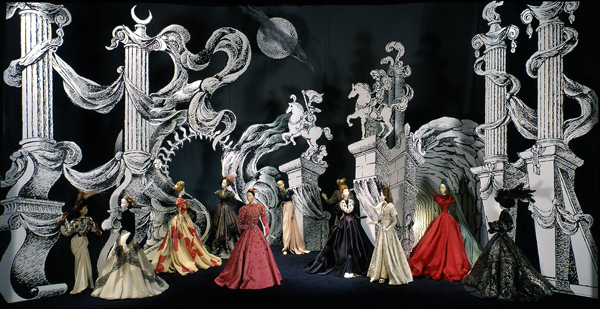
Robert Ricci came up with the idea of sets. Permits were required to secure lumber. Scenes represented, in part, the Bois, Île de la Cité , an elaborate dining room, and fantasies. Georges Geffroy, illustrator Christian Bérard (who acted as overall Artistic Director), and Jean Cocteau were three of many who created 20 sets (each with multiple dolls.) Cocteau’s was an homage to filmmaker René Clair and the only tableau visually acknowledging war. Designers were given carte blanche.
March 1945, the exhibition opened in the Grand Gallery of the Pavillon de Marsan of the Louvre Museum. More than 100,000 people visited over two months. Ready-to-wear didn’t exist. Not only did France’s citizens want to support relief, but they craved beauty. Additionally, to observe couture up close was a boon for those who sewed their own clothes.
The Théâtre then toured London, Barcelona, Leeds, Copenhagen, Stockholm,and Vienna. In 1946, after the previous year’s fashion was replaced on mannequins by new models, the show arrived at The Metropolitan Museum of Art, then went on to San Francisco. It was finally stored in the City of Paris Department Store (in acid-free boxes) until donated to Maryhill in 1952. To prepare for a rotating exhibit, mannequins and some sets were returned to Paris 1988-1990 to be conserved and/or replicated.

The Maryhill Museum now owns 172 dolls from 1946 (30 more have disappeared or been irreparably damaged) representing 52 designers for a single season. When asked why the figures landed in this country after an extensive 1980s tour, Grafe tells us the French didn’t want to pay duties for their return. Only the apparently real jewelry (Van Clef and Arpels and Cartier) was sent back overseas. One can only be incredulous.
We’re treated to a video about the original exhibit.
An entertaining and informative conversation.
Photos Courtesy of the Maryhill Museum
Opening: Théâtre de la Mode: “La Grotto Enchantée” (The Enchanted Grotto), original 1946 fashions and mannequins from set by André Beaurepaire (recreated by Anne Surgers); Collection of Maryhill Museum of Art
ABOUT MARYHILL MUSEUM OF ART: Housed in a Beaux Arts mansion on 5,300 acres high above the Columbia River, Maryhill Museum of Art opened to the public May 13, 1940, and today remains one of the Pacific Northwest’s most enchanting cultural destinations.
I’m new to Smithsonian Associates programs, but on the basis of these lectures, a fan.
Smithsonian Associates Streaming Programs
Next in this lunchtime series: The Hermès Carré: The History of Fashion’s Most Iconic Accessory. Monday, August 2, 2021 – 12:00 p.m. to 1:00 p.m. ET