“I found a safe place to have a voice. There are all levels of writing, and all levels matter.” – past International Women’s Writing Guild participant.
What a lovely way to describe the fellowship of the International Women’s Writing Guild (IWWG) which this past week hosted its Spring Conference “Write, Pitch, Publish” at the Poet’s House in downtown Manhattan. Offered to the 60 or so women attendees: a day of writing and publishing workshops with panels of industry experts; quite a full day at that when you hear that it began at 8:30 a.m. and went well past 6 p.m.
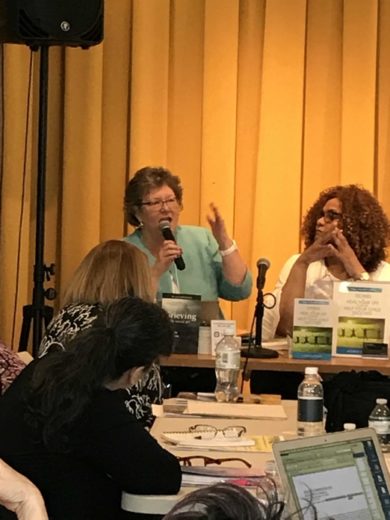
Lisa Irish, published author, raises a point as Andrene Bonner looks on.
After welcoming remarks, the attendees went to their respective workshops. In the main room, writer, and intuitive coach, Cathleen O’Connor, explained the “narrative arc” in fiction and non-fiction, while upstairs in the library, author and writing coach, Paula Chafee Scardamalia offered a “crash course” in how to sell a manuscript to an agent or editor. Both are experts in their respective fields and spent a generous amount of time answering questions and providing valuable insight and real-life examples.
O’Connor took the group through a few exercises on writing a narrative which follows a series of events from the start of the story and setting the scene, as the conflict starts to move the story. The arc continues as the action moves the story along, and then as the arc descends, there’s a reversal of the conflict, and gentle closing of the story. With illustrations and writing examples — on our own and in groups — O’Connor was able to hone in on the essential writing formula that began as she says, “in the days of Aristotle, who created the structure,” although his was the simpler Act 1, Act 2 and Act 3. Lastly, if we still needed more examples of the narrative style, we need only turn to a Disney movie. “Cinderella,” O’Connor shared, “has an excellent narrative arc.”
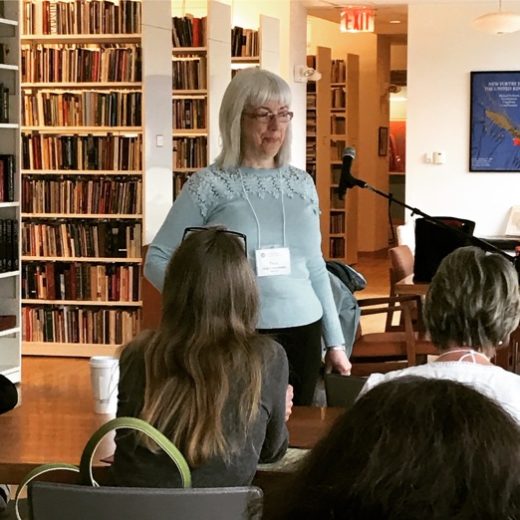
Paula Scardamalia presents her “pitch the agents” workshop.
Meanwhile, Scardamalia had an equally engaged group discussing how to pitch a fiction or non-fiction manuscript, and the questions kept coming. Her advice? Make your story idea unique, different and sellable. Don’t fill your pitch with unnecessary information that detracts from the written work, i.e., the author’s credentials, or previous works. Also, know your word count, not page count. “New writers,” she explains, “should only pitch stories that are no more than 90,000 words. Only established writers would be able to have the potential of selling something over 100k.”
After a catered lunch, the afternoon featured a “meet the agents” session, a poetry workshop, and an open mic section where attendees could read aloud their writing samples. And what writer’s conference would be complete without a chance for new published works to be celebrated, to be displayed, and to be signed by the author – so inspiring for the author to be. Guild President Judy Huge explains, “this event gives attendees a full experience of the path to publishing – to write, to pitch and to publish,” and is pleased to say that several of the attendees were invited to send in their proposals and sample chapters to the agents.
The IWWG, supports and encourages the creative community of women writers across all genres and at all ages. It has an annual week-long conference each summer (this year, it will be held July 6 – 13 at Muhlenberg College in Allentown, PA) and offers regional conferences in Boston and California. The IWWG’s Digital Village connects women writers from around the world with online workshops, panels, interviews, book clubs and support. It also provides writing contests throughout the year.
The Guild boasts that in its 41-year history, over 4,000 books have been published by its members. For more information on the IWWG, visit the website.
All pictures taken by Kelly DuMar.
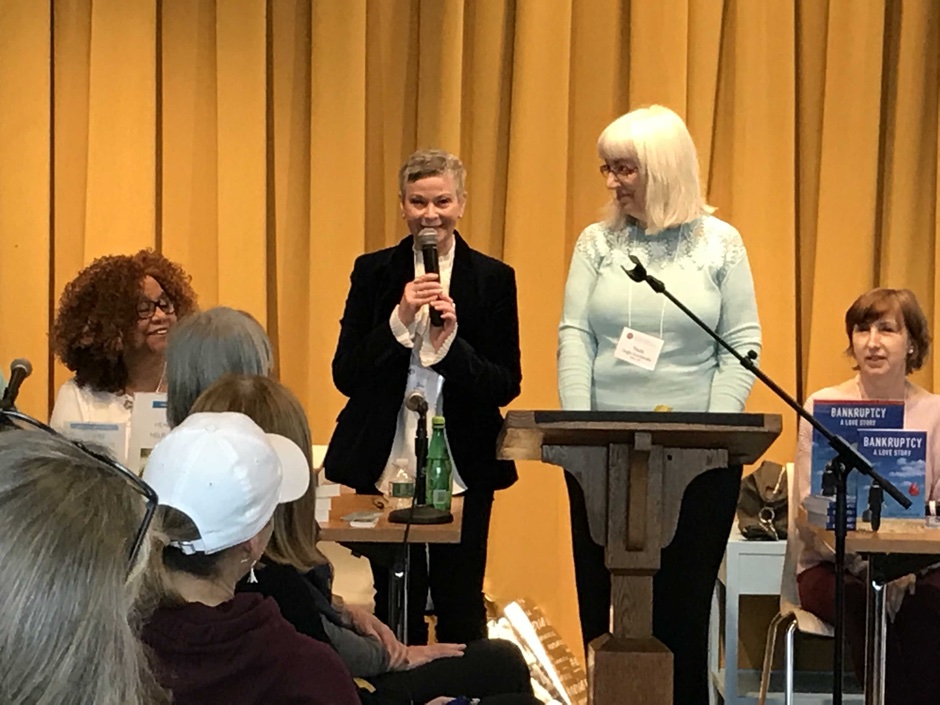
Top: Julie Maloney and Paula Scardamalia addresses the attendees, congratulating Guild members who’ve had books published.