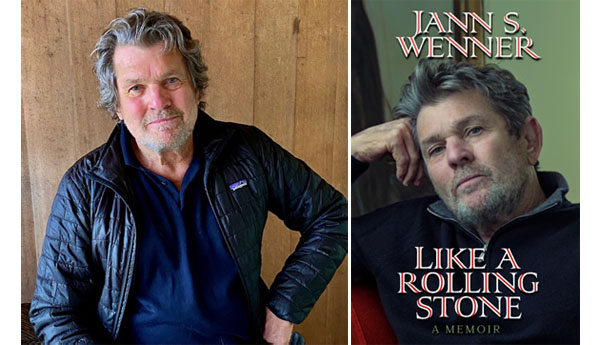
A review of Jann Wenner’s memoir, including parts of his conversation with Bruce Springsteen at the 92Y.
“…The truly subversive language we spoke was rock n’roll…The battle of the generations was for the soul of America…It was one of the most admirable periods in our nation’s history…What emerged was commitment to international peace, to human rights and racial and environmental justice, to shared responsibility and action, the potential for enlightened domestic and foreign policy…” Jann Wenner
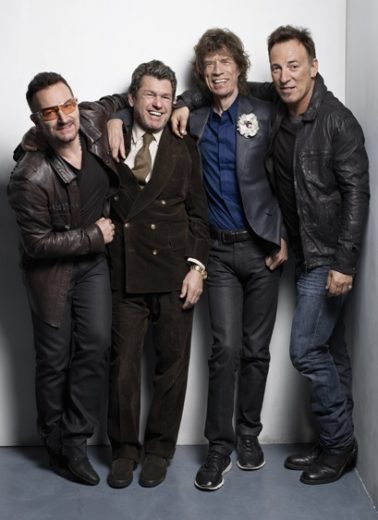
Bono, me, Mick (Jagger), Bruce (Springsteen) at the Hall of Fame 25th anniversary concert Photo by Mark Seliger
Those of you who think of the magazine Rolling Stone as strictly rock chronicles and Jann Wenner as its Pied Piper will not be disappointed, but the truth is this Zelig of our times illuminated culture as well as counterculture in print and picture for a longer period and better than anyone thought possible. Its founder, then editor/owner knew and/or was friends with the newsworthy in entertainment, the arts and politics. At the beginning, he was ingenuous, then, one assumes charming. Writing, if dense, is excellent. Specifics are such that one wonders if he kept a diary.
Wenner and Springsteen have been friends for 40 years. The musician was his interviewer of choice. They’re easy and warm together, a playful mutual admiration society. As he puts on his glasses and straightens a hearing aid, Springsteen notes they’re both old men now.
When Wenner was ten, Elvis Presley’s “Heartbreak Hotel” and Bill Haley’s “Rock Around the Clock” marked first awareness of the genre that would propel him to legendary status. Boarding, he worked on school newspapers and yearbooks, had an inkling he was gay, and faced the cusp of the 60s. Springsteen imagines boarding school as Lord of the Flies. Wenner tells us that unlike public education, it was full of kids at his “early intellectual level.” Then came the Beatles. “Just who I wanted to be. Adorable wise asses making music and being chased by girls.” At Berkeley, Bob Dylan and Joan Baez were “guiding stars…There was political protest, the beginnings of student protest. A lot of people went south to demonstrate.”

In my San Francisco office in typical form: smoking, talking on the phone, feet on the desk 1975 Photo by Annie Leibovitz
Life was politics, music, and psychedelics. Wenner met his future wife (25 years and three children). He was there at the first two massive, public acid (LSD) tests (raves), one hosted by The Grateful Dead, the other by author Ken Kesey (One Flew Over the Cuckoo’s Nest). He joined the The Merry Pranksters (Kesey’s ad hoc companions) on “The Magic Bus” and took road trips with Neal Cassidy (Jack Kerouac’s basis for Dean Moriarty) and Timothy Leary (the LSD Robin Hood). “You were with your tribe,” Springsteen comments. “The day I saw Rolling Stone on a newsstand, I thought – I’m not completely alone.”
Wenner freelanced articles on student protests and music. “I became an essayist, thinker, and minor voice of the rock and roll scene.” His first published interview was with Eric Clapton of Cream. Writer and jazzman Ralph Gleason, “the only one in the United States who took rock and roll seriously,” became his mentor. At 20, the founding edition of Rolling Stone emerged, created mostly by volunteers with $7500. “Ralph always said it felt like a letter from home. He was in his forties at the time. People used to joke that he was either 3- 16 year-olds or 4- 12 year-olds.” The autobiography exhaustively lists every major hire and fire. Credit where credit is due?

Jackie Onassis and Jann Wenner of Rolling Stone magazine share table at the Oyster Bar in Grand Central Station. The party they attended was for the “Save Grand Central Station” campaign. Bettmann/Getty Images
The editor was 22, Mick Jagger, 25, when they met. A lifelong friendship ensued. Stories are detailed. When Rolling Stone printed naked photos of John and Yoko rejected by their record company, another committed relationship was established. A day after Lennon was murdered, Yoko asked Wenner to come over. The magazine spot-lit “groupies” and introduced “The Plaster Casters” who literally made casts of rockers’ erect penises. (Jimmy Hendrix was the winner.) It miraculously functioned without business plan or projections.
“The thing about rock n’roll is that it stood for stuff, politics and society. Conventional wisdom at the time was that the two didn’t mix,” Wenner comments. In a late night conversation with Bob Dylan, Springsteen tells us, “He said it was a lot about the timing, but then you have to step up, to have the balls, make the music, start the magazine.”
Wenner went spelunking for ads. His wife Jane at home, he had gay sex. The author wouldn’t come out for many, many years. He established a London office. In the states, a first interview of Bob Dylan found a young folk hero, “clean-cut, neatly dressed, and carrying a book bag.” The magazine grew. “Jerry Garcia (The Grateful Dead) said I should stop hiring people once I started not remembering everyone’s names.” The office was freewheeling, often stoned, but the work got done.
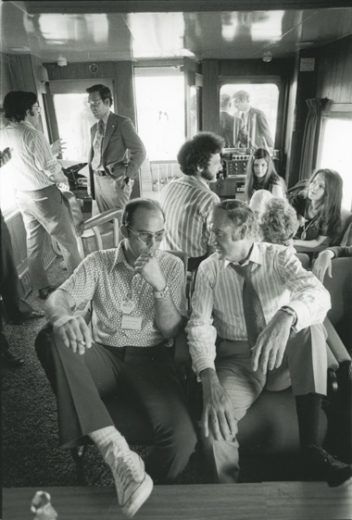
Hunter S. Thompson with George McGovern on the presidential campaign 1972-Photo by Annie Leibovitz
Violence at Altamount (Race Track, the site of a huge Rolling Stones concert) followed peace at Woodstock. In 1970, the magazine had 40 people on its masthead. “We had crossed the Rubicon… I came of age with my country in flames at home and abroad.” Civil rights, sexual freedom, Vietnam, and drugs were covered in depth. A fan letter from gonzo journalist Hunter S. Thompson opened a door to groundbreaking writing and crazy, sometimes dangerous encounters. (There’s much colorful documentation on these through the years.) “Hunter’s visits to Rolling Stone offices were performance pieces….I courted Tom (Wolfe), but Hunter was an accident. The editing I did for him was only because he never made the deadlines and I knew how to stitch the pieces together. I didn’t do much editing of Tom.”
The Wenners traveled. Joni Mitchell wrote, “I caught a plane to Spain/Went to a party down a red dirt road./There were lots of pretty people there/Reading Rolling Stone, reading Vogue” about a Wenner party. Jimmy Hendrix died at 27, Janis Joplin two weeks later. Muhummad Ali was the cover when he refused the draft. A National Magazine Award was won. “Jane managed friendships while I worked.” Photographer Annie Liebovitz came onboard and with tremendous creative freedom learned her craft. She became part of an extended family. The 100th issue featured Jerry Garcia with interviews of Francis Ford Coppola and Stanley Kubrick.
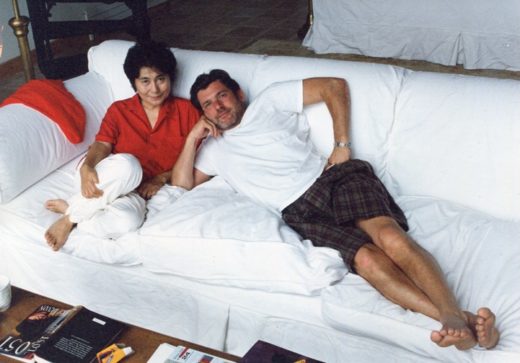
Yoko Ono in Mustique. We were together at Thanksgiving or Christmas every year- Jann Wenner Archive
Fear and Loathing in Las Vegas brought Hunter Thompson to wide public attention. Tom Wolfe eventually ran Bonfire of the Vanities as a serial in the journal. That June, Jann and Jane went to Morocco and spent time with author Paul Bowles. Rolling Stone broke the story of Patty Hearst after apparent assimilation and captivity. “Other than Watergate it was the scoop of the seventies.” His network extended wide and deep.
Wenner moved Rolling Stone back to New York from California. He was ambitious and Jane was wary of earthquakes. He became friends with Jackie Onassis (friends, not acquaintances), who reached out to him and started to employ Richard Avedon. Seventy-sixth in Time Magazine’s list of “Leaders of Tomorrow,” he was also the youngest. Announcing this to the staff, their fearless leader wore a three piece suit. Times had changed.
Springsteen asks who his toughest interviews were – Mick Jagger and Bob Dylan. “Neither wants to say much about themselves. They’re bored with it.” And easy ones? “Bono, yourself, and Pete Townsend.” Al Gore and Bill Clinton, Wenner adds, were intellectual show-offs while Obama was “this totally cool customer, speaking slowly in measured tones.”
John Belushi would show up at Wenner’s home unannounced at all hours. In fact, wherever he and Jane lived became a crash pad and way station for artists. Belushi shepherded them into the Saturday Night Live fold. Michael Douglas became a boon companion. Cocaine was everywhere. Often tired or hung over Wenner spent less time at the office. He bought a plane.
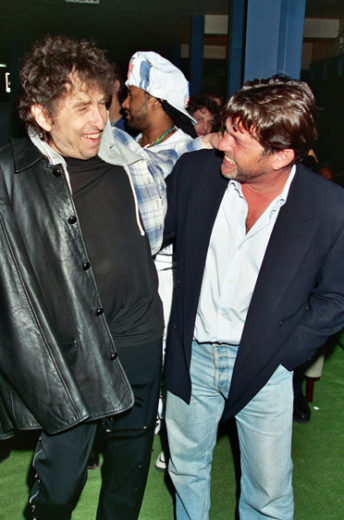
With Bob Dylan and Jann Wenner at the GRand Opening Concert of the Hall of Fame- Photo by Jeff Kravitz/FilmMagic/Getty Images
The NRA and AIDS were cover stories. Jane and Jann wanted to start a family. He stopped using coke and offered to pay for Thompson’s treatment. “No!” was the writer’s resounding response. Interviews with Madonna and Michael Jackson were featured. Jackson, who requested the piece, “spoke in a soft voice, sometimes a whisper, with a lot of ‘gee whiz’, saying little, asking a lot and listening closely.” Wenner never understood why the elusive star wanted an interview.
Springsteen asks whether anyone turned down the cover of Rolling Stone. Only Joni Mitchell is recalled. The artist grouses tongue in cheek about not achieving the honor with release of his album Born to Run. His friend counters that garnering covers of both Time and Newsweek made up for it. “He was an establishment pig at that point,” Wenner quips.
Several other magazines were started, some very successful. A designer whom Wenner had known long ago became his lover. “I had no intention of breaking up my marriage. I had beautiful homes and three sons dearly loved.” Still clandestinely gay, he didn’t account for falling in love and eventually moved out. It was not a good divorce. The new couple would eventually establish homes and extend their nuclear family by three. Columbine happened. The Twin Towers fell. Immigration and the environment were front page news.

With Paul McCartney(Jann Wenner) and Ringo Starr at the 30th Annual Rock And Roll Hall Of Fame Induction. Ringo and I laugh about finally meeting each other after fifty years. Photo by Kevin Mazur/Getty Images
Hunter S. Thompson died. In a chapter called “Hunter Redux,” Wenner describes how Johnny Depp attempted to pick up the mantle. Jane, his partner Matt, Bette Midler and Martin Short hosted the editor’s 60th birthday. There were three banquet tables, each with 50 guests. Springsteen performed a song he’d written for his friend.
Financial vicissitudes with his other magazines took juggling. Buyers came courting. “What would I do with myself? What would I do with all that money?” Wenner asked himself. Son Gus started an internship. He would eventually take over. Hillary’s campaign was a priority as was Donald Trump. Wenner suffered physical ailments. He had serious back issues and open heart surgery. Springsteen comments on the author’s candid, unselfconscious relating of events. His doctor mentioned how good it was to have music playing. Springsteen and his wife Patti Scialfa made Wenner a six-hour mix tape for the operation.
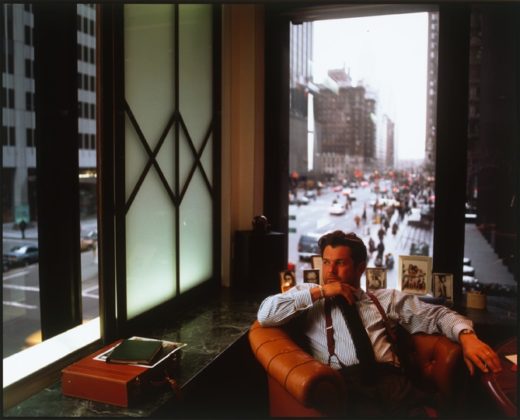
Annie shot this for a Vanity Fair feature. I am looking sourth on Sixth Avenue and 52nd Street. Ward Bennett designed the office, and I was there for nearly thirty years, the office I finally called home. -Annie Leibovitz
A last letter from the editor reflects on afterwards. “‘Forever Young’ was a generation’s mantra, an unforgettable Bob Dylan song. We all knew what it meant, that we stay young in our outlook, our actions, and our hopes. I have always tried to keep that in mind.” At 75, Wenner walks with a cane. His six kids and two spouses are fine.
Springseen asks whether Wenner thinks rock n’roll is still vital. “Yes, but not with the same intensity. The sixties were an historical moment, so many artists creating at the same time, so much happening socially and politically. I don’t think we’re going to see that again. Some of you still carry a huge message, though, writing about your own lives and those around you… As a magazine editor, I was finding stories when no mainstream media was interested. Rolling Stone was a charter to examine all aspects of America.”
“I don’t think any magazine could do that today,” Springsteen responds. “As somebody who was in the outlands, I needed to be reminded there was another life waiting. The magazine provided fuel and companionship. You did a good job. Thanks.”

Jann Wenner, Bruce Springsteen
Jann Wenner has had a helluva life. What you read above is the tip of the iceberg. He was smart, insightful, dogged, liberal, ready to party and ahead of his time. “…the ocean rolls in and the sun makes the ocean sparkled. The dog sleeps at my feet.”
All biographical photos courtesy of Little Brown and Company.
Y image courtesy of the 92St Y
Check out other lectures, interviews and classes – in person and streamed.
Like a Rolling Stone by Jann S. Wenner