In the 19th Century, it was believed libraries would eliminate bookstores. Radio, television, movies, mass market paperbacks, superstores, ebooks and, of course, the behemoth, Amazon were successive threats. (Jeff Bezos summarily announced Amazon would put an end to all independent bookstores.) Two decades ago, there were 13,499 bookstores in the United States. Many then flagged and disappeared. Today there are 46,688.
Bookstores have never just been about books. Author Even Friss calls them “sites for intellectual, social, political, and cultural exchange…the measure of of a town.” A bit idealistic, but true often enough to keep them alive against the odds. Research takes us through a colorful history of bookselling shops often doubling as printers, publishers, marketers, and purveyors of merchandise.
Benjamin Franklin’s establishment carried school books, religious texts, poetry, almanacs, and pamphlets. He was a printer, an editor, a publisher, and a writer before politics came calling. Franklin went to London to buy books. What didn’t sell, he auctioned off. Men of means paid 30 to 40 percent above cost. In Virginia, James Rivington carried 782 titles. Among them was Mr. Franklin’s Very Celebrated Experiments in Electricity and Thomas Paine’s Common Sense.
Ralph Waldo Emerson, Oliver Wendell Holmes and Harriet Beecher Stowe were patrons of Boston’s The Old Corner (which became Ticknor and Fields). Few people read for leisure. Even in the 19th Century, stores kept books in boxes or bins, piled high with edges rather than spines showing. They were often grouped by publisher to make inventory easier. Reader had to know what they were looking for. Also a publisher, principals of the Corner, told Louisa May Alcott she couldn’t write and should stick to her teaching. They did publish Uncle Tom’s Cabin.
In 1908, Roger Mifflin spent summers traveling up and down the East Coast selling books out of his especially rigged car. Seven years later, he sold to Helen McGill who considered the calling an adventure. Sustainability required about $1.50 a day. McGill inspired other women. Madge Jenison and Mowbray-Clarke set up their venture, Sunwise Turn, on East 31st Street. It was one of the first bookstores to look homey with art, curtains and comfortable seating. Unlike the usual dusty, warehouse appearance, the shop was neat and clean.
Friss’s chronicle is filled with stories of entrepreneurs and the often quirky results of their endeavors. Between larger chapters are observations such as wrongheaded architecture, bookstore cats, and the smell of a bookstore. Early on, “customers stank, soap was expensive, baths an occasion.” Chemicals used for printing, glue, bindings and paper added to overpowering scent. The “romance” of it never wavered. In 2020, Powell’s Bookstore in Oregon sold a unisex fragrance called Powell’s by Powell “with notes of wood, violet and biblichor.” (The ephemeral smell of bookstores.)
By 1925, Chicago hosted 164 bookstores including a book department in Marshall Field’s. Marcella Hahner’s curated section quickly grossed more than ten times what a bookstore might take in. Publishers Weekly called it “monumental.” Fields employed display artists, instituted recommendations, and featured grouped genres. “When they ordered 2500 copies of The Joy of Cooking, the store wasn’t just guessing the market, it was making one.” Still, in 1930, 85 percent of U.S. towns had no bookstores. Sears Catalog stepped in. The Scarlett Letter was 49 cents, Hound of the Baskervilles, 58 cents. Book of the Month Club began. Over time, paperbacks were embraced. Dalton, Walden Books, and Brentano’s opened.
More detailed chapters are given to such as Frances Steloff’s fabled, bohemian Gotham Book Mart which Norman Mailer called, “One of the last bookstores you can pick up literature, not commerce.” The shop, Friss notes, looked like a combination of “a disheveled English professor’s office, your grandmother’s living room and a Parisian Café.” It especially attracted those in arts and letters.
Steloff would push manuscripts into the hands of editors and sell then-illicit books, like Henry Miller’s The Tropic of Cancer, under the counter. She almost single-handedly popularized Edward Gorey. Readings and book parties – featuring beer and chips – were frequent. Gotham also stocked Little Mags, first editions, second-hand copies and experimental literature.
The Strand is given worthy space as perhaps the lone survivor of Book Row, 4th Avenue between 8th and 14th Streets, where dozens of purveyors traded with each other. “If I wanted to make profit, I’d sell herring,” one 4th avenue shop owner declared. When The Department of Sanitation decreed outdoor stalls had to be removed, many gave up. By the mid 70s, however, the relocated Strand had 1.5 million mostly extremely affordable books on unfinished shelves. The company’s slogan remains “18 Miles Of Books.”
Poet Lawrence Ferlinghetti founded San Francisco’s City Lights in 1953. It was and perhaps still is, Beat Central, featuring literary explorers of all stripes in print and in person. When the paperback-only bookstore started to carry hardcovers, many thought all was lost. In fact, new owner Paul Yamazaki drew a line elsewhere. The store rarely carries best sellers.
“Len Riggio always intended Barnes & Noble to be a different kind of bookstore.” We follow the chain’s trajectory from a single text book locale to a nation of superstores selling toys, cards, wrapping paper, mugs, all kinds of small loosely related items. You can sit on a window sill or in a café (B & N was one of the first to institute these) and peruse a book you haven’t purchased. The children’s department is full of little ones sprawled on carpets being read to. Manhandled volumes are undoubtedly written off.
The book references, in part, Three Lives, The Oscar Wilde, A Different Light, Drum & Spear, Powell Books, BookPeople, McNally Jackson. A number of authors have opened bookstores. Among these, Ann Patchett’s Parnassus Books is just fine, thanks, while Larry McMurtry’s ambitious Booked Up recently sold off nearly 300,000 volumes and plans to close three of its four stores. There’s a chapter on sidewalk selling, one on the rise of Amazon, stories about eccentric characters, the establishment of organizations, and changes in marketing.
Sometimes the next generation takes over. Nancy Bass Wyden (The Strand), Emily Powell, and Sarah McNally Jackson followed in the footsteps of their parents. The Argosy is run by its founder’s three daughters. In New York, we have bookshops specializing in mystery, travel, cookery, poetry, biographies, Judaica, theater, history…The Ripped Bodice romance bookstore in Brooklyn opened after publication, but surely would have merited discussion. “Bookstores can be actors…even the little ones can shape the world around them. They already have.”
An entertaining read – and guide – for any reader less concerned with commerce than community.
(There are evocative black and white photographs in the book.)
All unattributed quotes Evan Friss
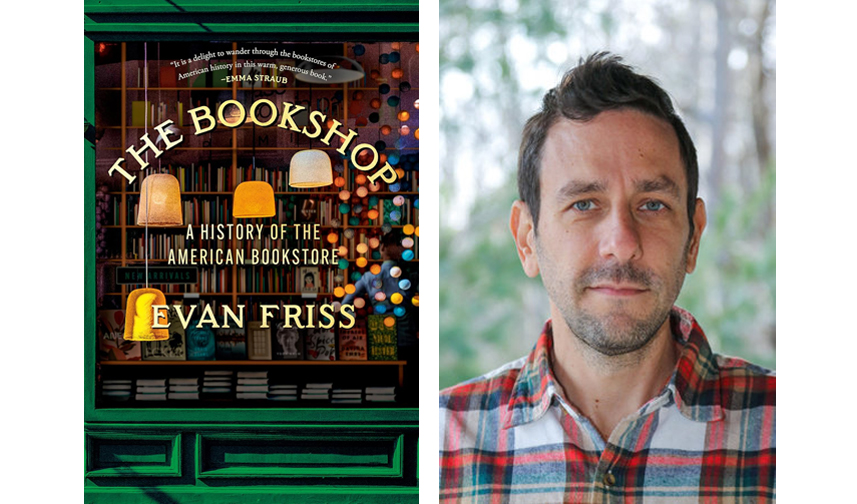
The Bookshop – A History of the American Bookstore by Evan Friss
Author Photograph – Joanna Eldredge Morissey
Our editors love to read and independently recommend these books. As an Amazon Affiliate, Woman Around Town may receive a small commission from the sale of any book. Thank you for supporting Woman Around Town.