This exhaustively researched book should be on the shelves of every musical theater teacher as well as those discussing feminism and women’s studies. Three hundred often neglected females from the 18th century (a revelation) to the present are noted and sketched with increasing thoroughness as years pass.
There are composers, arrangers, lyricists, librettists; some theater historians, directors, show doctors and choreographers; women who moved from on stage to off stage; those who wrote for Tin Pan Alley, pop, or rock before theater; some who collaborated with husbands. Distaff creators tackled social issues as well as entertained.
In the 1790s, Ann Julia Hatton was the first woman to write a libretto – for Her Tammany – about the love interest of the Native American chief, Tamanend, namesake of New York’s Tammany Hall. Lyrics were both original and adapted from Native American songs. From 1905-1928, Anne Caldwell wrote book, music and lyrics to over 30 Broadway shows becoming a charter member of ASCAP. Presciently her first hit was a modernized Cinderella, the second, a contemporary Aladdin. With Sigmund Romberg, Dorothy Donnelly wrote two of the most popular shows of the 1920s: Blossom Time about the life of Franz Shubert, revived five times through 1943, and The Student Prince, longest running musical of the era.
Lyricist/librettist Dorothy Fields has 400 songs from the 20s to the 70s to her credit, including “I Can’t Give You Anything But Love.” It was Fields who came up with the idea for Annie Get Your Gun. When Jerome Kern passed away, Irving Berlin agreed to step in only if he authored both music and lyrics. Dorothy was sidelined to co-writing the book. Fields’ work includes, in part, A Tree Grows in Brooklyn, Sweet Charity, Two for the Seesaw.
Tepper cites Kay Swift as the first woman to be the sole composer of a Broadway hit, 1930’s Fine and Dandy, which satirized the social classes. She was also the namesake of Gershwin’s Oh, Kay! The two
were friends, confidantes, lovers, and almost married. Bella Cohen Spewack collaborated with her husband Samuel on the book of Kiss Me, Kate, which won the very first Tony Awards for Best Musical
and Best Book of a Musical.
In the 1940s, Betty Comden and Adolph Green joined forces to become the longest running writing team in musical theater history. First performers, the pair collaborated on, in part, On the Town, The Band Wagon, Bells Are Ringing, Subways Are for Sleeping, Applause, and The Will Rogers Follies, not to mention The Band Wagon and The Barclays of Broadway for film.
Carolyn Leigh, first an advertising copywriter, penned 500 songs including “Witchcraft” and “The Best is Yet to Come.” At 27, she contributed lyrics to Peter Pan (with Mary Martin) and would go on to join
Cy Coleman on How Now Dow Jones. Mary Rodgers (read her book Shy), with Marshall Barer, is best known as lyricist and co-creator of the recently revived Once Upon a Mattress, originally a project for resort getaway, Camp Tamiment.
With her husband Alan, Marilyn Bergman created “hit songs and Hollywood smashes” including “The Way We Were,”“Nice N’ Easy” and the lush score of Yentl. Their musical Ballroom fared less well though one song, “Fifty Per Cent,” has become a cabaret staple. Micki Grant, who started as a performer, put the Black experience to song with Don’t Bother Me, I Can’t Cope. Lyrics covered religion, education, prejudice, and the intersection of feminism and black power. “Writer, educator, disrupter” Elizabeth Swados started by composing music for a production of Medea at La Mama. Nightclub Cantata, Doonesbury, and the exuberant Runaways followed.
The only libretto credit for Winnie Holzman is Broadway, now film blockbuster Wicked. Having contributed to theater and TV pieces, she was drawn to “the whole idea that…what you think you know, you don’t know.” Lynn Ahrens, arguably one of our great book writer/lyricists, has professionally partnered with composer Stephen Flaherty 40 plus years. Among their many musicals: My Favorite Year, Once On This Island, Ragtime, A Man of No importance, The Glorious Ones, and Anastasia.
A 1990s chapter features, in part, five time Tony Award winning director/choreographer Susan Stroman, who has received multiple “conceived by” credits; Jeanine Tesori morphing from dance arranger, conductor, musician to Broadway composer with Thoroughly Modern Millie, Caroline, or Change, and Shrek, the Musical; and book writer Marsha Norman’s The Secret Garden, The Color Purple, and The Bridges of Madison County.
Notables in the 2000s include Nell Benjamin who with her husband Laurence O’Keefe, co-wrote music and lyrics for Legally Blonde; co-composer/co-lyricist of The Drowsy Chaperone, Lisa Lambert; Pulitzer Prize winner Quiara Alegria Hudes whose best know theater libretto is In the Heights; Dolly Parton’s “countrified pop” 9 to 5 which lasted 148 performances.
The last chapter is titled Celebrities, Playwrights, and Crossover Artists. Here, Tepper calls out Suzan-Lori Parks, Lisa Kron, Cyndi Lauper, Claudia Shear, Sara Barielles, Shaina Taub, and Tina Fey among others. If you’re reading this review, you’re likely familiar with most or all of them.
A fascinating collection.
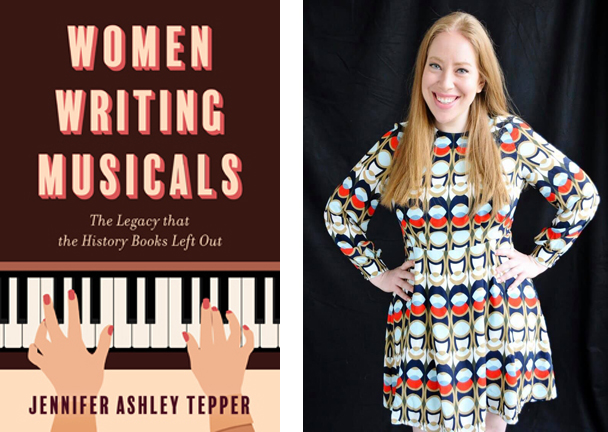
Cover and author portrait courtesy of the publisher
Opening: Dorothy Fields and Arthur Schwartz work on score of “A Tree Grows in Brooklyn” / World Telegram and Sun photo by Walter Albertin, Library of Congress Prints and Photographs Division. (Public Domain)
Women Writing Musicals
Jennifer Ashley Tepper
Our editors love to read and independently recommend these books. As an Amazon Affiliate, Woman Around Town may receive a small commission from the sale of any book. Thank you for supporting Woman Around Town.